10 January 2014

Try fixing it first

We have made a commitment that whenever something at our house breaks, wears out or otherwise stops working, we will try to fix it before considering throwing it away and/or replacing it.


It's a commitment I suspect most parts of the world - and most previous generations in our part of the world - would be astounded to know even needed articulating.


To aid in our endeavours, we have established the 'fixing box'. It lives in a high place in our living area (it's got enough brokenness in it already without putting it where Small Boy can reach!). Mostly when toys get broken I am too busy with other things to be able to immediately repair them, so they go into the fixing box to wait for a fixing session.

Results of two Fixing Box sessions (above and below)
 

(As a parenting tip: the fixing box also works a treat for things broken beyond repair that threaten floods of tears if they head towards the bin: into the fixing box with 'we'll have a look later to see if we can fix it' followed by a good few weeks hidden in the box usually means they get completely forgotten and can be disposed of without fuss at a later date).

Tyson's (tiny) shed is also something of a 'fixing box'. Although some may interpret that as 'unruly pile of rubbish' I am confident that fixed things do eventually emerge from there.
 
Eva at Sydney Airport, aged two
And if it really can't be fixed (like this much loved bag) we salvage what we can for future projects.

I'm particularly proud of this ugg-boot re-soling using fabric from old jeans
Fixing most things does not require fancy tools or equipment. I have a sewing machine. Tyson has no workshop and his tool kit is pretty basic. For a work bench he clamps a hunk of recycled timber beam to the ladder, and works in the back courtyard.


When special tools are required (very occasionally) he borrows from his dad, who has a much more extensive collection. If this is not an option for you (because you don't know his dad... or don't have a handy friend or family member with lots of tools) there may be a tool library near you. Or just put the word out to your networks that you need something - its amazing what people have lying around.

Fixing also rarely requires special knowledge or skills, although it sometimes requires a bit of confidence to give something a try. For example, yesterday Tyson transformed three derelict kitchen chairs from this:


to this:


The only 'special tool' was a staple gun - very easy to use. These chairs were verge pick-ups originally and were about to head that way again.


Eva helped with sanding back so the paintwork could be resprayed. I said encouraging things and took photographs. Small Boy supervised.


Fixing furniture may seem daunting but it is often not that difficult - and so rewarding! I once re-strapped an armchair with only a hammer, tacks and strips of old jeans, and it lived for many more years.

Initial Time: This varies from a couple of minutes to glue a piece of toy back on or sew a quick button to projects requiring research, part-shopping and considerable work. Tyson is more likely to do those ones than me. But to be fair, he gets a great deal more pleasure out of figuring out & implementing cunning make-do fixes than I do. There's a lot of the Ken John in him (his grandfather). The chairs above took about 1.5 hours each - a little longer for the two that he re-glued (loose joints).

The fixing box method takes about two hours every three months to have a blitz on accumulated broken things.

Initial Cost: Again, this varies enormously. Most things can be fixed with a bit of thread, tape or glue, which I estimate costs us about $25 a year. 


Some fixes are a huge cost saving - like the car door latch pictured above. Tyson did that for me last Christmas for about $45 (cost to join online Picasso-owners forum, and buy a manual and a just-right tool) and half a day fiddling around, after the Citroen mechanics quoted us $1000+ for the same work.

Others cost more in dollars and/or time than it would take to just buy a new one.


Pedestal fans are a good example of this. You can pick them up for $10-$20, and every year there must be hundreds of them put out on hard-rubbish days because of minor faults. We have three and Tyson is getting quite good at stopping their odd rattles, making them turn (or not, depending on the problem) or getting them started again when they have apparently died. Pedestal fans should be kept out of land fill! They use about 50W of electricity compared with our reverse cycle air-conditioner which uses 2.5kW. That is, our aircon is equivalent to running fifty pedestal fans together.

Ongoing time or cost commitment: As above, ongoing.

Impact: Australian households produce an estimated seven million tonnes of waste per year. Our average rubbish per person is higher than Canada, Germany or the UK (although less than the USA). LivingSmart illustrates this quantity graphically as each Australian family producing the amount of waste it would take to fill a three-bedroom house from floor to ceiling. Compressed. Every year.

It is crucial that we don't put anything into the waste that doesn't need to be there. Fixing everything we can is a big step towards that.


It also gives much joy. Here that pesky pram handle finally comes good.


And as a household norm, it helps to set our children's default to 'fix' rather than 'bin'.

PS: I just want to clarify that the reason I am not in any of the photos is not because I don't do any fixing; its because I take all the photos. Except when Eva takes them, when focus can be a bit optional. Here's one of Eva's to prove I do fix some things myself:


Links:

Tool libraries in Brunswick VIC and Angle Park SA

Wikipedia article on tool libraries including links to tool libraries all over the world

Or find your local men's shed and take your project there to use their tools. (If you're a bloke, presumably. I understand that men's sheds are an important men's mental health initiative, but... I would like to have somewhere I could take my project too! I guess I could try the Australian Sewing Guild but I would prefer to wrestle the staple-gun away from Tyson and have a go at upholstery)


LivingSmart data on waste

Living Smart Queensland offers a free online course to help you reduce your household footprint - tips, calculators, information, suggestions... its good stuff.

10 December 2013

Get ready for Christmas - give something away

I have decided it is time to initiate a new family custom around times of receiving gifts - birthdays and Christmas: give something away in preparation.
 

Tyson and I had a go at giving away some of our books. We are book-lovers and book-hoarders, so this was quite a challenge! They are destined for charity - most likely Save the Children. (Their annual book sale at UWA raises upward of $250,000 for their work, and they now have a permanent second-hand book shop at Belmont Forum, which is near to us)

I packaged up a box of baby clothes for a friend who is expecting a third child... having given away all their baby things after the second child got beyond baby.

And I asked Eva and Edan to give away one toy each. (OK, I did this on Edan's behalf, as he is too little to understand). We have one-year-old and four-year-old birthday parties to attend this week, so rather than buy gifts our children have selected something of their own. In good condition, of course, and it had to be something they had enjoyed and played with, not a 'reject'.

Not for giveaway! But he does love climbing into boxes... and everything else...
I am hoping that this can become a family practice - the new normal - and that both we and our children might learn to let go of stuff and live with less. And to appreciate the new things all the more.

We are also preparing with this lovely Advent calendar from my sister in PNG
Initial Time: About an hour going through the bookshelves and baby clothes

 Initial Cost: Zero

Ongoing time or cost commitment: Five times a year we do it again - four birthdays and Christmas. I anticipate the time commitment will vary depending on what sort of stuff we turn our eyes to. At birthdays only the birthday person will be looking for something to give away.

Impact: None of the items leaving the house this way would have gone to landfill. Never. Not on my watch. But I understand that in other homes baby clothes, books and outgrown toys DO join the mountains of landfill our culture produces.

I am aiming for more intangible impacts of generosity, lightness of ownership, reducing my propensity to hoard, and gratitude for what we keep.

For other Christmas ideas, see my two posts from last year.

Post Script update: I thought we were pretty bold getting the kids to give away one thing each - until I had a cuppa with my friend who had got her kids to give away one toy each... EACH DAY through December, as their lead-up to Christmas. Her kids are five and nearly eight and they managed it just fine. 

19 October 2013

Back to Basics: Boiling the Kettle

How much energy does it take to boil the kettle? Is it more than I need to use?


Some time ago I realised that I almost always overfill the kettle, and I have been working at reducing how much water I put in. It took a while to get the hang of it, but I can now say we are committed to putting in only as much water as we intend to use. As my mum and dad are visiting from Victoria for a couple of weeks, our kettle is working extra hard and it seemed timely to publish this commitment.

This is a simple post about a simple action in tune with our original intention to take up one additional act towards sustainable living per month. 

Initial Time: zero - but it did take many months to change old habits. 

Like my habit of filling and boiling the kettle half an hour before guests arrived, so they wouldn't have to wait so long for their cuppas. This then required reboiling the kettle when they arrived and often I had more hot water than I needed because I didn't know in advance how many cuppas I would be making. I can't think of a guest to our house who would mind waiting a few extra minutes for their hot drinks.

Or the practice of someone in this house (who shall remain un-named) of boiling the kettle then an hour later remembering the cuppas have not been made so reboiling the kettle... and perhaps  remembering this or the next time to actually do something with the water...

Initial Cost: zero - a cost saving (see below)

Ongoing time or cost commitment: zero

Impact: When I fill our kettle I am generally boiling around 1.25L more water than I need. It takes 430.5kJ to heat 1.25kg of water from 18°C (ambient temperature) to 100°C (boiling). This is equivalent of approximately 120Wh. 

To put that in perspective, every time I boil a full kettle to make one or two cuppas, the excess energy I am using is equivalent to leaving two sixty Watt light globes on for an hour, or to having our energy-saver 20 Watt kitchen light on for six hours.

If I boil the kettle full four times a day, in a year I would have used 174.5 kWh of electricity doing nothing at all - boiling water I don't need. Our Perth electricity company currently charges 26 cents per kWh (unit) and we have opted for a natural power premium of an extra 5 cents per unit. This means our commitment to only boil the water we need is saving us $54 per year (plus GST - total close to $60).

[for those interested in formulas: 

change in temperature (ΔT) x mass (M) x heat capacity of water (C), 
where ΔT=82°C M=1.25kg C=4.2kJ/kg°C = 430.5kJ
1 kWh = 3.6MJ
0.4305 / 3.6 = 0.1195kWh = 120Wh

0.1195kWh x 4 boils per day x 365 days = 174.47 kWh]

Thanks Tyson for knowing the formulas... I'll have a cuppa next time you're boiling...

30 September 2013

Celebrating our four-year-old

I was surprised how interested you were in my post about our one-year-old's birthday so have decided maybe it is relevant to share a bit about how we celebrated Eva turning four this month.


This was a much anticipated birthday for our girl - but not because she wanted presents or even a party. No, the most important thing was that she moved up the pre-schooler hierarchy from 'Three And A Half' to 'Four'. It has been made clear to me by the one who knows best that such a transition is a very important matter. 


Rather than a 'party', with all the associated expectations and activities, we invited Eva's three best friends to join us for half a day playing at Landsdale Farm. Eva had been there not so long ago and wanted to share this favourite place with her friends. We are fortunate that we avoided socially awkward choices about excluding others, as none of these closest friends are from the big kindy friendship group. 


We talked it up as 'a play to celebrate Eva's birthday' rather than a 'birthday party' and insisted gifts were unnecessary, but all three guests still brought gifts. 


However, these friends know us well and no-one went silly with gifts. At least two of the three guests had been allowed to (and wanted to) choose their gifts themselves, which resulted in gifts that were exactly what a four-year-old wanted - as chosen by a four-year-old and a three-and-a-half-year-old - even if not quite exactly what their parents had in mind. I loved that the kids were encouraged to be involved in choosing.


Gifts are tricky. There was not one gift Eva was given, from friends or family, that was not very appreciated, thoughtfully chosen and lovingly given; not one that I would want to return or am not thankful for. And yet the net outcome is that a whole lot more stuff has come to dwell at our place. For next time I am considering ways to do a 'give away' in preparation for any time of receiving. Still working on that.


Rather than 'party food' we took what we would ordinarily take for a picnic outing, and ate it out of the packets or off our laps rather than from fancy single-use disposable 'party wear'.


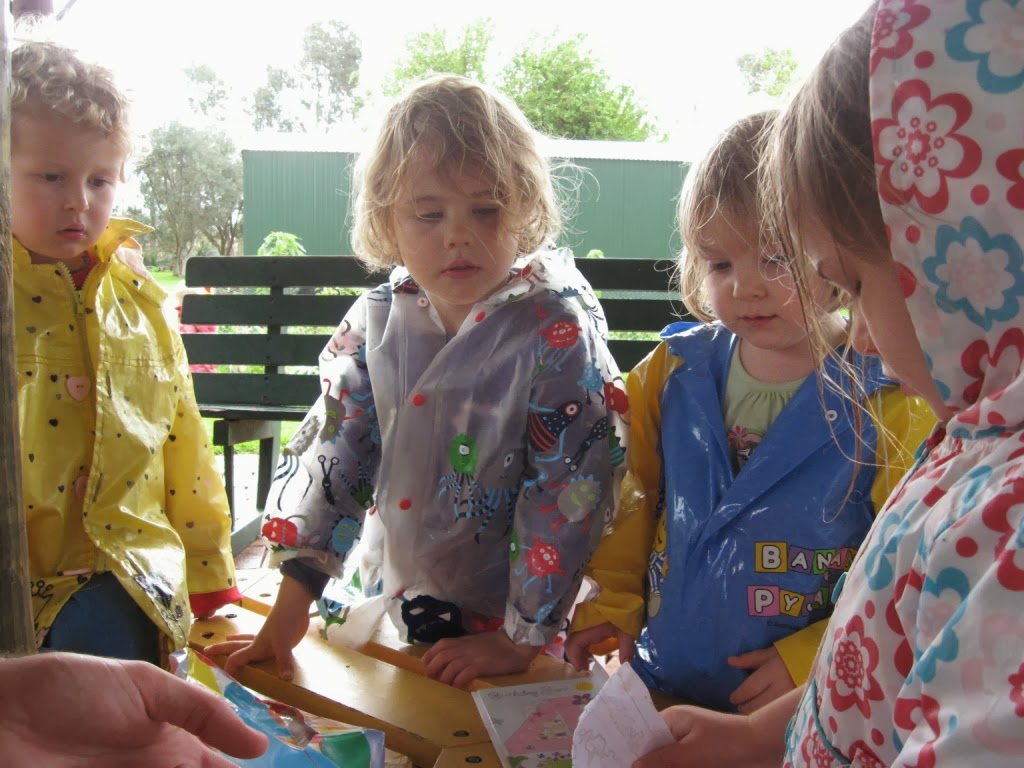
All the children had a blast, even (especially?!) in the rain. 


You would have been forgiven for thinking the main event was not the farm, though, but the half-hour drive in our car with all the children in the back. 


Yes, this is why we bought a seven-seater. We could nearly have driven them the length of the freeway and back and considered the birthday well celebrated without even getting out of the vehicle!


On her actual birthday we had hidden the gifts we bought for her around our room, wrapped in pretty fabric as described at Christmas. Eva loved hunting them out - hide and seek is one of her most favourite games at present.


Our six gifts were: two picture books, a set of wooden alphabet magnets, a train tunnel (her particular request), heart-shaped post-it notes, and a small plastic car & horse trailer & horse. I think I bought too many gifts (although a $4 train tunnel and a $2 pad of post-it notes, though received and used with much glee, are not exactly exorbitant). I am not a great success at living smaller, just one person having a go, and the lovely things on offer for children easily get me in. This time around I didn't check how sustainably the timber for the toys was produced, and the horse trailer etc I confess was a complete impulse buy of unnecessary plastic on a day Eva had enjoyed driving behind a horse in traffic. However, it was at least bought from our lovely local independent toy store rather than some bulk-rubbish warehouse store.


Breakfast was her choice: dippy eggs on this occasion, although she has many breakfast favourites and Tyson could have been up for a trickier cook than that!


We gathered with Tyson's family for an afternoon tea picnic at Eva's favourite local play area, Tomato Lake, which involved much bolting around with cousins and eating food brought by all to share. Cake by Grandma again - she's very good at that. Eva had asked for a red snail cake.


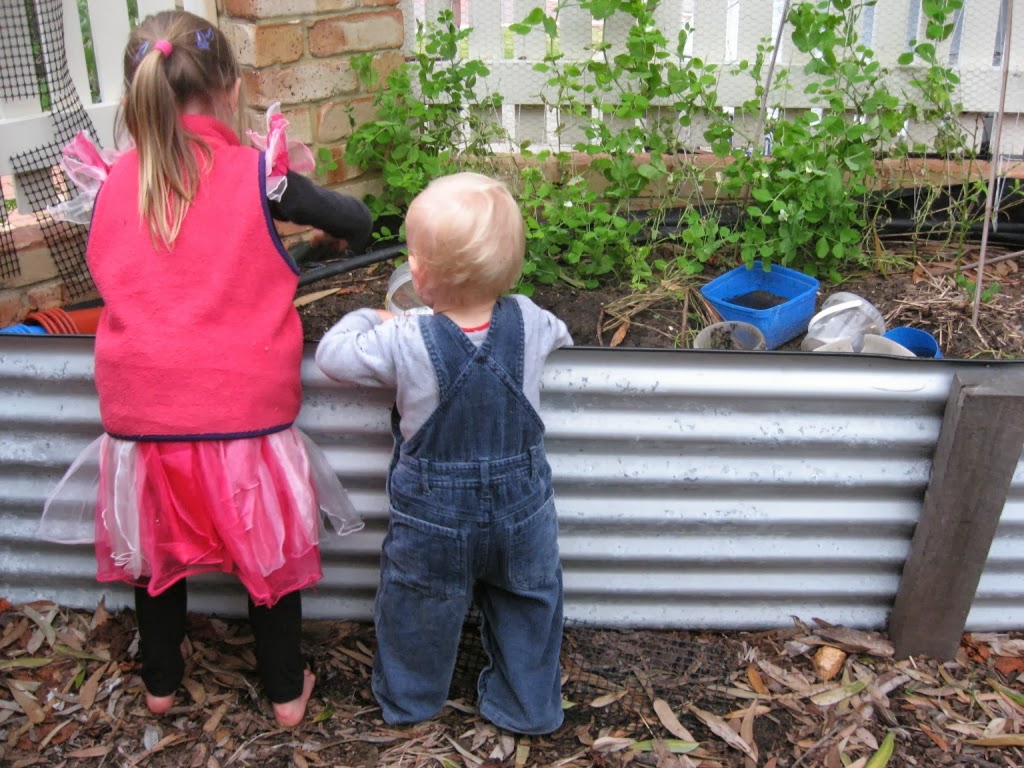
Of course if you're going to dress in a frilly pink outfit, you need to do a bit of gardening too...


The next day we went to the zoo with her my-side cousin. We often go to the zoo, as we have season passes, so that wasn't a particular treat in itself, but we only go on the carousel for special occasions. Because it was Eva's birthday we let the girls have two rides. That's very near to paradise.


Her kindy, church and Wiggly Woo all sang happy birthday and gave her a small something (sticker, chocolate, pencil). Her Children's Church leader cut watermelon into a cake shape, stuck in candles, and made it a birthday morning tea - especially thoughtful, as Eva doesn't really eat cake. We bought a bag of chocolate frogs and gave them out at kindy. Tyson made sure his rostered day for parent help at kindy was in the birthday week. One evening in the week after her birthday we went out to dinner as a family at a local restaurant we often frequent, where Eva likes to order and devour an enormous chicken parmigiana, and made note to her that it was another part of remembering her birthday. 


And perhaps most importantly I tried very hard to make her birthday and days around it days of 'yes'. So often when at home with two small children I find myself saying 'no' all day. Now and then I set myself a day of 'yes' - where unless it is dangerous, expensive or impossible I do my level best to say 'yes' to what Eva suggests, even if it is not the most convenient choice or not the one that I personally would enjoy most. I never tell her it is a 'yes' day, I just do it, and usually the result is a happy day all around. Why don't I do it every day? (Because I am too often tired and grumpy and sometimes things do need to get done... before next Christmas...)

Happy birthday to our precious girl. We love you lots and can't believe you are four already.


The usual 'time/ cost/ impact' section that would go here doesn't make a lot of sense for this one. The impact is as per what I wrote about birthdays in July but it is intangible and impossible to quantify. The whole birthday cost us about $100 I think, including $6 farm entries for four kids and $4.50 bag of chocolates for kindy kids, but I didn't keep track closely so that may not be entirely accurate. Dinner at the restaurant is not in that amount - can't remember how much that was.

Thanks parents for allowing me to include photos of your lovely children on my blog.

18 August 2013

Australian native jam

Do you know Lilly Pillys? Those bright pinky-purple berries that grow in many Perth yards, in hedges and public gardens, and on rambly old overgrown properties? I love the way they look and I like their name - its sounds quirky-romantic to me. 


As of last month, I now also love that they are edible, that they are an Australian native, and that they grow in our neighbour's yard between our two driveways.


So we were making jam again.


Eva was so excited by the idea that we could harvest these beautiful berries and make something edible that she was the main motivation for the project.


It was Greg's idea, though, and he put me onto this recipe, which we followed. I checked the internet to be sure I had lilly pillys and found there are over 60 different species of lilly pilly and all of them are edible.


The recipe calls for one lemon and 1kg of sugar per 1L of lilly pilly pulp. We doubled the amount of lemon, and wouldn't have wanted any less.


Next time I think I would go for a 3:4 ratio of sugar to pulp, as the 1:1 ratio has given us jam that is sweeter than it needs to be.

pulp coming through the sieve - it really is that colour

BUT: it is surprisingly delicious, and very beautiful. 


no it didn't boil down that far - I tipped it into a bigger pan so I could supervise it less closely
Six jars of lovely jam - 2L of pulp, about 2.5L of jam once sugar and lemon juice was added.


As I put too much water in when boiling the lilly pillys, I was left with a couple of litres of bright pink liquid once they were all scooped out. 


This I put in the fridge and used as a herbal tea. With half a teaspoon of honey per large mug, heated in the microwave, it was fantastic!


I am so excited that I cooked an Australian plant! OK, I don't think its native to the southwest of WA where I actually live, but at least its not from the northern hemisphere...

This is now our third jam-making session in less than a year (see posts on strawberries and nectarines). We are a big jam-eating house, but even so we are more than keeping up a supply for all our needs and gifts for friends. I am therefore now prepared to commit to NO MORE BUYING COMMERCIAL JAM.
 
Initial Time: About 3.5 hours - although the stove-top sections didn't require constant supervision, so actual labour time was closer to 2.5 hours (1/2 hour harvesting; 1/2 hour washing and preparing; 1/2 hour boiling; 1hr smooshing through a sieve to get seeds out and thin the pulp - this is the really labourious bit; 1/2 hour cooking; 1/2 hour bottling and cleaning up)

Initial Cost: About $2 for a bag of sugar. We remembered this time to get lemons from Grandma, and (with our neighbour's permission) the lilly pillys were free. She found the jar we gave her too sweet for her taste but her grandkids loved it.

Ongoing time or cost commitment: Half a day every three or four months to make whatever the latest seasonal jam will be.

Impact:

Australian household spend on average about $1 per week on jam, with each Australian eating around 2kg of jam per year. We are a net exporter of 'jams, spreads, pastes, etc' - around $12mill worth per year, a small portion of the approximately $625mill annual export of substantially processed fruit and vegetable from Australia, and a blip beside the approximately $1.6bill of processed fruit and vegetables imported. Food and vegetable processing in general employs around 75,000 people in this country. (more stats here - from 2011-12). So not buying jam is not about reducing reliance on food imported from overseas. Very little if any of the jam available in supermarkets is produced in Western Australia, however, so we are reducing our food miles for produce trucked across Australia (I really hope it is trucked. Surely we don't need to fly our jam around? Actually I would love to think it was brought by rail... there is always hope, surely?)

Commercial manufacture of food products involves all manner of inputs and dependencies, such as: transport fuel, transport network, communications, banking services, electricity, gas, water (HEAPS of water is used in commercial processes!), chemicals for cleaning, preservatives to extend product life, packaging materials (including their production and transport)...

Think about it for a jar of jam:

Lid - sourcing raw materials (mining), processing them into a workable form, shaping the metal into a lid, adding labels (inks, dyes, etc and sometimes paper), at each of these stages transporting the stuff to the place where the next stage happens, at each stage a business operation with a footprint of all it takes to run an office (at bare minimum) and possibly a factory or a mine site. Quite likely a mine site that flies workers in and out every day or so.

Jar - sourcing raw materials (mining), turning them into glass (I'm no expert but that needs HEAT!!), shaping into jars. And at each stage another round of transport and business footprints.

Label - sourcing raw materials (forestry), turning them into paper, graphic design work, adding dyes etc to print and finish, glue to attach to jars. Add transport. Add business bits and pieces like the office coffee machine, toilet-flushing for all those staff, and replacing the carpets every few years...

Jam - sourcing raw materials (fruit, but also sugar, preservatives, corn syrup - although to be fair the Cottees and IXL jars I have left over in my pantry from before the jam-making began both have very few ingredients beyond fruit, water, citric acid and pectin), all the inputs required for horticulture including many pesticides, and lots and lots of water; all that is required to fit-out a factory for production.

And each piece has more sub-pieces that have their own chain of impact - Where did the glue come from? Where does the dye come from? What chemicals are used to clean all the equipment needed along the way? What materials are the machines in the factories made from?

By comparison our lilly pilly jam used:  recycled glass jars; about 30L of water to wash berries and jars, gas to run the stove; electricity to run the oven to sterilise the jars; no electricity for light or heating or cooling as we worked during the day on a nice winter's day; petrol to transport lemons from Grandma to us (but we didn't make a special trip); and all the supply-chain stuff above for commercially produced sugar - especially HEAPS of water that it takes to grow sugarcane. Our equipment (stove, our kitchen, the stainless steel saucepans, mixing bowls and spoons, plastic lemon squeezer) all comes from somewhere and has its own footprint.

Impact on my lifestyle: The only thing I may miss is ginger marmalade, unless I can find an acceptable recipe to try, and a cheap-enough source of ginger.

PS: North American friends, we Australians use 'jam' for what you call 'jelly'. 'Jelly' here is what you call 'jello'. Not so great on toast.